The world is constantly changing, but some things remain the same. Start with the right questions – not what the latest tech can do, but how humans think, work and live best together.
Business
In the workplace, we help you to navigate the complex and the unknown to achieve the worthwhile.
Maintaining a focus on trust, adaptive leadership, consistent values and foresight remains just as important as understanding how technology can help and hinder us to navigate this dispersed, virtualized, emergent environment. Knowing how these elements impact each other, and why human proximity and connection remains vital to team synchrony, collaboration, complex thinking and trust, lets us use AI discerningly and ensure it delivers real advantages. Productivity, trust, skills and learning will increase instead of drop, and the cultural and professional risks of agentic AI are minimised. Such tailored partnerships ensure that individuals and entities adapt, engage and thrive in current and future environments.
Government
Fiona sits on a number of national and global entities concerned with fostering high trust, flourishing societies. Areas include the societal and economic aspects of AI use for quality outcomes; building innovative work economies; designing global policy for aged care, and creating human centric health, aging, education and technology sectors that enable connection and caring which is scaffolded by technology that is trusted and transparent (Fiona is speaking at the global AI for Good conference in Europe in 2027). She also works directly with government bureaucracies to help tailor their best hybridity to allow them to use both human and artificial intelligence to their best strategic / operational and cultural advantage.
ATSE
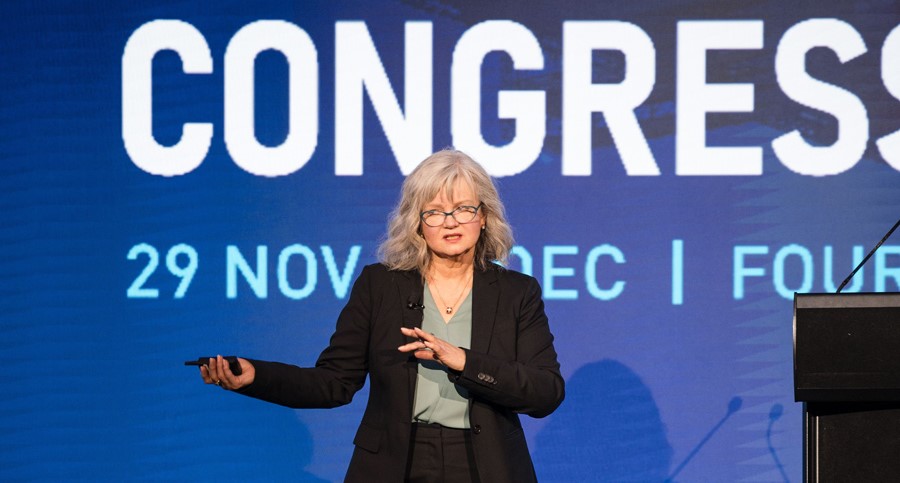
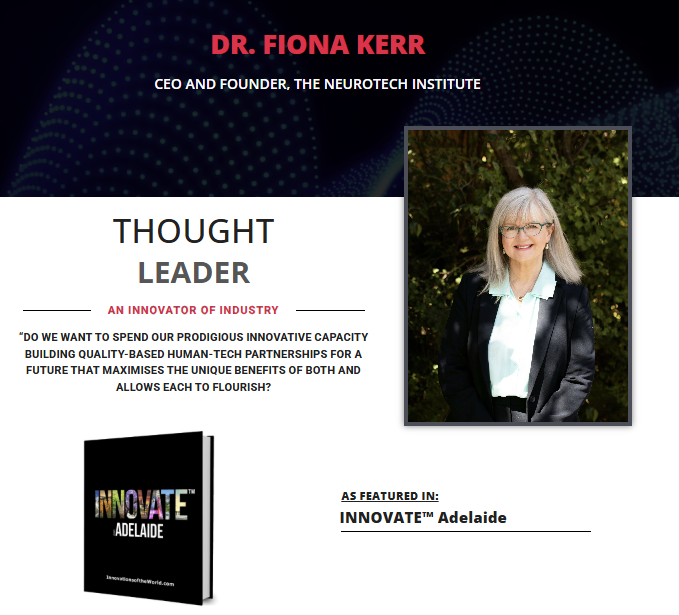
“Dr Fiona Kerr is at the forefront of shaping a future that is technology powered and human centred. As founder of The Neurotech Institute, she combines unique expertise across cognitive neuroscience, anthropology, psychology, engineering, and complex system dynamics to address how we use emerging technology, when not to technologise, and ethical practices. Her trailblazing research debunked the assumption that humans exhibit the same level of complex and moral decision-making when interacting with trusted autonomous systems as they would with another human in close proximity. This critical discovery holds implications for defence personnel, doctors, surgeons, analysts, CEO’s and first responders and how they work with technology. She is a trusted advisor on ethical use of artificial intelligence, serving a range of board and organisational roles. She is also a skilled science communicator, delivering numerous keynotes annually.”
I delight in the intricacies of human and technological innovation, and two forces that shape its scope and quality: understanding the unique strengths each brings, and the calibre of the question or goal we innovate around. Human connection and synchrony sparks novel, diverse ideas — aligning perspectives into wider, more complex approaches to the problems we’re solving. When technology partners well, rather than distracting, it enables ideation, helping us realise ideas and imagine new ways to design and deploy it.
The question is key. Long-lens, quality goals — not short-term profit or attention — produce cleverer solutions at the frontier of knowledge: leveraging breakthroughs, surfacing surprises and benefits, and revealing what not to technologize.